Quick answer
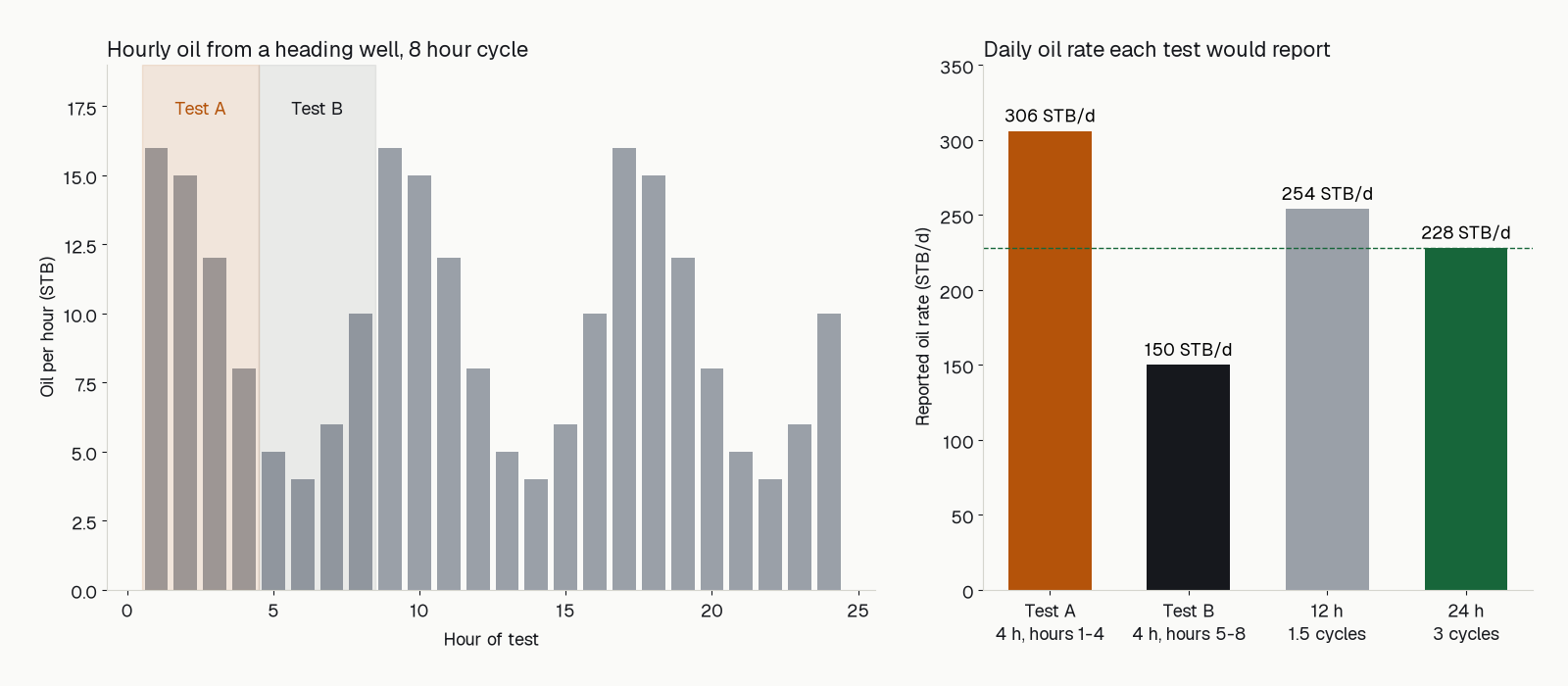
Start the test once the well is stable, then run it long enough to cover several whole flow cycles; 24 hours is common, and the US offshore rule sets a 4 hour minimum. On a well heading on an 8 hour cycle, a 4 hour test can report 306 or 150 STB/d when the true rate is 228 STB/d.
On this page
There is no single correct length. Run the test after the well is stable and long enough to cover several complete flow cycles, then convert the measured volumes to daily rates. For routine production tests that often means 24 hours, and many operators also use 8 or 12 hour tests on steady wells. Some regulators set a floor: the US offshore rules ask for at least 6 hours of stabilized flow and then at least 4 hours of test, while Texas annual oil well tests are 24 hours.
The length matters less than what the test window contains. A 4 hour test on a well that heads or slugs on an 8 hour cycle can report an oil rate that is a third too high or a third too low, depending on when it started. A longer test that cuts a cycle in half carries the same kind of error, just smaller.
This post covers what the rules ask for, how to tell a well is ready, and a worked example showing how window length and start time change the reported rates.
What the rules ask for
Regulatory minimums differ by jurisdiction and test type, so check the rule that applies to your well. A few published examples:
| Rule | Stabilization before the test | Test length | Gas base conditions |
|---|---|---|---|
| US offshore, 30 CFR 250.1152 | At least 6 consecutive hours at a stabilized rate, after load fluid is recovered | At least 4 consecutive hours | 14.73 psia and 60 °F |
| Texas annual oil well test, 16 TAC 3.53 and Form W-10 instructions | Normal operating conditions at a stabilized rate | 24 hours | 14.65 psia and 60 °F |
| Alabama production test, Rule 400-2-5-.03 | Stabilized rates | At least 4 hours, at most 72 hours without approval | Not set in this rule |
Base pressure is a convention that differs between these rules: 14.73 psia offshore and 14.65 psia for Texas W-10 gas. Record which base your gas meter reports at, because the same gas gives slightly different Mscf at each base.
Internal test schedules
Company procedures are often stricter than the regulatory floor because the test also feeds allocation and surveillance. A published SPE paper on Permian Basin wells (summarized in JPT) describes test separators set up with predetermined durations of 8, 12 or 24 hours.
How to tell the well is ready to test
The clock should start only when the separator is measuring this well's normal production and nothing else.
Purge the previous well
When a well is switched into a shared test separator, the vessel and lines still hold the previous well's fluids. Let enough time pass to displace them before you start counting volumes, or the first hours of the test belong partly to another well.
Recover load fluid and let rates settle
After a workout, stimulation or choke change, the well produces back load fluid and its rates drift. The offshore rule above requires recovering the fluid put into the formation before testing. On any well, compare rates over consecutive equal intervals (for example, hourly oil and gas totals) and start the test once they stop trending.
Find the flow cycle
Rod-pumped wells cycle with pump-off controllers, intermittent gas lift cycles with the injection schedule, and some flowing wells head or slug. Look at the separator trend or the dump counts and note how long one full cycle takes. The test should cover whole cycles, ideally several of them.
If the well cycles, choose a test length that is a whole multiple of the cycle and long enough to hold more than one. A 24 hour test covers three 8 hour cycles; a 12 hour test covers one and a half.
Worked example: same well, four test windows
The numbers below are an illustrative well, not field data. They show how the reported rates move with the test window when nothing about the well changes.
Assumptions
- The well heads on a repeating 8 hour cycle and is otherwise stable.
- Oil volumes are in stock tank barrels (STB). Water is in bbl. Gas is separator gas in Mscf at the meter's base conditions.
- The separator has been purged and no load fluid is coming back.
- No BS&W, shrinkage or meter corrections are applied.
- Hourly volumes over one cycle, repeated for 24 hours:
- Oil (STB): 16, 15, 12, 8, 5, 4, 6, 10, for 76 STB per cycle
- Gas (Mscf): 14, 13, 11, 9, 8, 8, 8, 10, for 81 Mscf per cycle
- Water (bbl): 10, 10, 9, 8, 8, 8, 8, 9, for 70 bbl per cycle
Converting a test to daily rates
Each daily rate is the measured volume times 24 divided by the test hours:
- Daily rate = volume × 24 / test hours
- Water cut = water / (oil + water) × 100
- GOR = gas (scf) / oil (STB)
The 24 hour test
Over three full cycles the well makes 228 STB oil, 243 Mscf gas and 210 bbl water.
- Oil: 228 × 24 / 24 = 228 STB/d
- Gas: 243 × 24 / 24 = 243 Mscf/d
- Water: 210 × 24 / 24 = 210 bbl/d
- Total liquid: 228 + 210 = 438 bbl/d
- Water cut: 210 / 438 × 100 = 47.9%
- GOR: 243,000 scf / 228 STB = 1,066 scf/STB
An 8 hour test that covers exactly one cycle gives the same answers: 76 × 24 / 8 = 228 STB/d, and so on.
Two 4 hour tests
Test A runs hours 1 to 4: 16 + 15 + 12 + 8 = 51 STB oil, 47 Mscf gas, 37 bbl water. Test B runs hours 5 to 8: 5 + 4 + 6 + 10 = 25 STB oil, 34 Mscf gas, 33 bbl water. The multiplier is 24 / 4 = 6.
| Result | Test A, hours 1 to 4 | Test B, hours 5 to 8 | 24 hour test |
|---|---|---|---|
| Oil rate (STB/d) | 306 | 150 | 228 |
| Gas rate (Mscf/d) | 282 | 204 | 243 |
| Water rate (bbl/d) | 222 | 198 | 210 |
| Water cut (%) | 42.0 | 56.9 | 47.9 |
| GOR (scf/STB) | 922 | 1,360 | 1,066 |
Test A overstates oil by 34% and Test B understates it by 34%. Water cut and GOR move too, so a 4 hour test on this well could suggest a water or gas problem that does not exist.
A 12 hour test
Hours 1 to 12 cover one and a half cycles: 127 STB oil, 128 Mscf gas, 107 bbl water. That reports 254 STB/d oil, 256 Mscf/d gas, 214 bbl/d water, 45.7% water cut and 1,008 scf/STB. It is longer than one cycle and still 11% high on oil, because the extra half cycle is the high-rate half.
A longer test is not automatically a better one. If the window does not hold whole cycles, the leftover part of a cycle biases the result. On a cycling well, match the test length to the cycle.
Recording the test so it can be compared
Two tests on the same well only compare cleanly if you can see how each one was run. On the test record, write the start and end time, the test hours, the choke or pump settings, the purge time, the gas base conditions, and whether the oil is reported as STB at the stock tank or as separator liquid. The GOR guide and the water cut guide cover those two calculations in more detail.
WellersDen takes the test duration and the produced oil, gas and water volumes and returns the daily oil, gas, water and total liquid rates, water cut and GOR, with an optional PDF report. It does not apply BS&W, shrinkage or meter corrections, and it cannot tell whether your window covered whole cycles, so that check stays with you.
FAQ
Is a 24 hour well test always required?
No. It depends on the regulator and test type. Texas annual oil well tests are 24 hours, while the US offshore rule sets a 4 hour minimum after 6 hours of stabilized flow.
Can I scale a short test to a daily rate?
Yes, multiply each volume by 24 divided by the test hours. The result is only representative if the well was stable and the window covered whole flow cycles.
How do I know a well has stabilized?
Compare oil, gas and water totals over consecutive equal intervals. When they stop trending and only repeat the normal cycle, the well is stable enough to test.
Why do two tests on the same well disagree?
Common causes are different test lengths or start times on a cycling well, an incomplete purge of the previous well, load fluid still returning, or different gas base conditions or oil reporting basis.